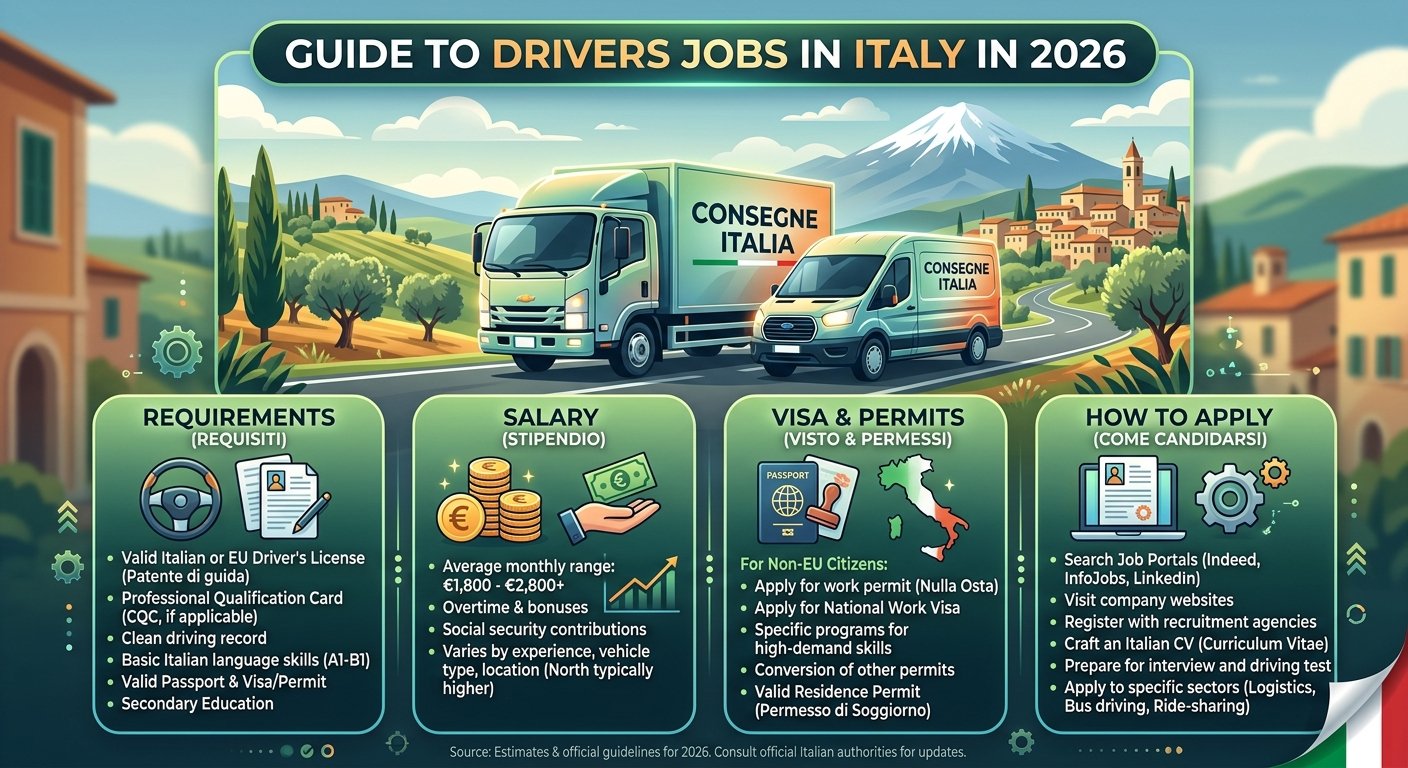
Drivers jobs in Italy can be an attractive career option for qualified drivers looking for employment in Europe. Italy has demand for different types of professional drivers, including truck drivers, delivery drivers, bus drivers, van drivers, and other transport professionals.
For international applicants, however, getting a driving job in Italy involves more than simply finding a vacancy. You may need the correct driving licence, professional qualifications, a legal work permit, and an employment contract.
This complete guide explains drivers jobs in Italy, common job types, requirements, salaries, work permits, where to find vacancies, and practical tips for avoiding fake job offers.
Drivers Jobs in Italy
Italy has a large transport, logistics, distribution and tourism economy, creating opportunities for qualified drivers in several sectors. Professional drivers may work for logistics companies, freight operators, delivery businesses, construction companies, public transport operators, and other employers.
The European EURES labour-market information identifies truck and lorry drivers among professional profiles that can be difficult for employers to recruit in parts of Italy, although demand varies by region and occupation.
Across Europe, heavy truck drivers have also been identified as a shortage occupation, which helps explain why experienced commercial drivers may find opportunities in different European labour markets.
However, a shortage of drivers does not mean every applicant will automatically receive a job, visa, or work permit. Employers still normally require the appropriate qualifications and experience.
Types of Driver Jobs in Italy
There are several categories of driving work available in Italy.
1. Truck Driver Jobs
Truck drivers transport goods between warehouses, distribution centres, factories, ports and customers.
Typical duties may include:
- Driving heavy commercial vehicles
- Loading and unloading goods
- Checking delivery documents
- Inspecting the vehicle
- Following scheduled routes
- Maintaining delivery records
- Following road-safety regulations
Long-distance truck driving may involve regional, national or international routes.
2. Heavy Truck Driver Jobs
Heavy vehicle drivers generally require higher-level driving qualifications than ordinary car drivers.
Employers may look for candidates with:
- Appropriate heavy-vehicle licence
- Professional driving qualification
- Commercial driving experience
- Knowledge of road-safety regulations
- Good driving record
- Ability to complete delivery documentation
For international applicants, it is particularly important to confirm whether their existing licence and professional qualification can legally be used in Italy.
3. Delivery Driver Jobs
Delivery drivers transport packages, food, retail products and other goods to customers and businesses.
Depending on the employer, the job may involve:
- Van driving
- Parcel delivery
- Route planning
- Customer service
- Digital delivery systems
- Loading packages
- Obtaining delivery confirmation
These jobs may have different licence and language requirements from heavy-truck positions.
4. Bus Driver Jobs
Bus drivers may work in:
- Urban public transport
- Regional transport
- Tourism
- School transportation
- Private coach companies
Bus driving normally requires the appropriate category of driving licence and professional qualifications.
5. Courier and Van Driver Jobs
Courier drivers deliver parcels and small shipments. These positions may be available with logistics companies, courier businesses and local delivery services.
Requirements can vary considerably between employers.
6. Construction and Industrial Driver Jobs
Some companies employ drivers to operate or transport specialized vehicles and equipment.
Examples can include:
- Construction vehicle drivers
- Concrete mixer drivers
- Specialized transport drivers
- Industrial vehicle operators
- Machinery transport drivers
The exact qualification depends on the vehicle and job duties.
Driver Salary in Italy
One of the most common questions from job seekers is: How much do drivers earn in Italy?
There is no single salary for all drivers. Pay depends on the vehicle category, experience, employer, region, working hours, routes and applicable collective agreement.
Factors that can affect earnings include:
- Driving experience
- Type of vehicle
- Local versus long-distance routes
- Professional qualifications
- Overtime
- Night or weekend work
- International routes
- Employer and collective agreement
- Region of employment
Applicants should therefore be cautious about websites advertising a guaranteed salary for every driver.
Italy does not have one EU-style statutory minimum wage that simply applies to every worker. Pay protection can depend heavily on employment contracts and collective bargaining arrangements.
Tip: Before accepting an offer, ask the employer for the gross salary, working hours, overtime arrangements, allowances, deductions and applicable collective agreement.
Requirements for Drivers Jobs in Italy
The requirements depend on the specific driving position.
Common requirements include:
Driving Licence
You must have a licence that legally permits you to operate the relevant vehicle.
A normal car licence is generally not sufficient for professional heavy-truck or bus driving.
Professional Qualifications
Heavy commercial and passenger transport jobs may require additional professional qualifications.
Applicants should check the Italian requirements for the specific vehicle category and type of professional transport.
Driving Experience
Many employers prefer candidates with commercial driving experience.
Experience can be particularly valuable for:
- Heavy trucks
- International transport
- Refrigerated vehicles
- Tankers
- Long-distance routes
- Specialized transport
Medical Fitness
Professional drivers may need to meet applicable medical and fitness requirements.
Clean Driving Record
Employers may ask for evidence of a good driving history and may check previous violations depending on the position.
Language Skills
Italian language ability can be an important advantage.
Drivers may need to communicate with:
- Customers
- Warehouse workers
- Dispatchers
- Police or authorities
- Mechanics
- Employers
For international routes, additional languages may also be useful.
Can Foreigners Get Driver Jobs in Italy?
Yes, foreign nationals can work in Italy when they meet the applicable immigration, employment and professional qualification requirements.
For people who are not citizens of the EU/EEA, the process can involve an employer-sponsored work authorization and an appropriate visa.
Italy’s 2026–2028 immigration quota program (Decreto Flussi) provides routes for legal entry of foreign workers. For 2026, the program authorizes 76,200 entries for non-seasonal subordinate employment, alongside separate quotas for self-employment and seasonal employment.
Importantly, this does not mean that every driver automatically qualifies for a work permit. The occupation, employer, quota category, nationality, documents and current immigration rules all matter.
Italy Work Visa for Drivers
If you are a non-EU citizen living outside Italy, you generally need to follow the legal immigration process before starting employment.
A typical process may involve:
- Finding an eligible Italian employer.
- Receiving a genuine employment offer.
- The employer completing the required work authorization procedure.
- Obtaining the necessary authorization under the applicable immigration rules.
- Applying for the appropriate Italian visa, where required.
- Entering Italy legally.
- Completing the required residence and employment formalities.
- Meeting the professional driving requirements before beginning regulated driving work.
The exact procedure can change, so applicants should use official Italian government information rather than relying on social-media agents or unofficial promises.
Is Visa Sponsorship Guaranteed?
No.
A website or recruiter claiming “100% guaranteed Italy driver visa” should be treated with caution.
A legitimate employer cannot guarantee that immigration authorities will approve every application.
Before paying any recruitment fee, verify:
- Company name
- Company registration
- Job location
- Employment contract
- Salary
- Working hours
- Licence requirements
- Work authorization process
- Visa requirements
Never send money simply because someone promises a guaranteed European job or visa.
Driving Licence Requirements for Foreign Drivers
This is one of the most important issues for international applicants.
Having a driving licence from another country does not automatically mean you can permanently use it for professional driving in Italy.
The rules can depend on:
- Country that issued the licence
- Licence category
- Residency status
- Type of vehicle
- Whether the country has an agreement with Italy
- Professional driving requirements
Heavy truck and passenger transport positions can require additional professional qualifications.
Therefore, before accepting a job, confirm with the relevant Italian authorities whether your licence can be recognized, converted or otherwise used for the intended job.
Documents You May Need
Depending on your situation and the employer, you may be asked for documents such as:
- Passport
- Driving licence
- Professional driving qualification
- CV
- Employment references
- Driving experience records
- Police or background documents where applicable
- Medical documentation where required
- Employment contract
- Work authorization documents
- Visa and residence documentation
Do not assume that every employer will request exactly the same documents.
Where to Find Drivers Jobs in Italy
Job seekers can use several legitimate channels.
1. EURES
EURES is the European employment network and provides information about jobs, labour markets and working conditions in Europe.
Its Italian labour-market information specifically identifies truck and lorry drivers among profiles that employers can have difficulty recruiting in some regions.
2. Italian Public Employment Services
Italy’s employment system provides access to job vacancies and employment services.
EURES explains that Italy’s public employment services and Cliclavoro can be used to search for employment opportunities.
3. Company Career Pages
Search the career pages of established:
- Logistics companies
- Freight companies
- Distribution companies
- Courier businesses
- Transport operators
- Manufacturing companies
Applying directly can reduce the risk of dealing with an unverified middleman.
4. Reputable Recruitment Agencies
Some recruitment agencies specialize in transport and logistics.
Before working with an agency, verify its identity, legal status, job details and fee structure.
How to Apply for Driver Jobs in Italy
A professional CV can make your application much stronger.
Your CV should clearly show:
Personal Information
Include your name and appropriate contact details.
Driving Experience
Explain:
- Years of driving experience
- Vehicle types
- Local or international routes
- Previous employers
- Main responsibilities
Licence Details
Clearly list the relevant licence categories and professional qualifications.
Work Experience
Start with your most recent driving position.
Languages
Mention your Italian and other language skills honestly.
Additional Skills
Useful skills may include:
- GPS/navigation
- Digital tachograph knowledge
- Vehicle inspection
- Delivery documentation
- Basic vehicle maintenance
- Route planning
- Customer service
Tips for International Drivers Applying From Abroad
If you are applying from outside Italy, follow these steps:
Step 1: Check Your Licence
Find out whether your licence is valid for the intended driving job and whether conversion or additional qualification is required.
Step 2: Build an Italian-Style CV
Use a simple, professional CV that clearly explains your driving experience and qualifications.
Step 3: Search Legitimate Vacancies
Use reputable job portals, EURES, public employment services and company career pages.
Step 4: Verify the Employer
Search for the company’s official website and business information.
Step 5: Ask for a Written Offer
Do not rely solely on WhatsApp messages or verbal promises.
Step 6: Understand the Immigration Process
If you are a non-EU applicant, determine whether the employer can legally hire you under the applicable immigration rules.
Step 7: Never Pay for a Fake Job
Be especially careful with recruiters demanding large payments for a guaranteed job, visa or work permit.
Common Scams Targeting Foreign Job Seekers
International job seekers can be vulnerable to employment scams.
Be cautious if someone:
- Guarantees a visa
- Guarantees a job without an interview
- Requests money before providing documents
- Uses only a personal email address
- Refuses to provide the employer’s legal name
- Sends a suspicious employment contract
- Promises unusually high pay for little work
- Requests passport documents unnecessarily
- Pressures you to pay immediately
A genuine job opportunity should provide enough information for you to independently verify the employer and employment conditions.
Advantages of Working as a Driver in Italy
Professional driving can offer several potential advantages.
Employment Opportunities
Transport and logistics are essential to the Italian economy, and experienced drivers may find opportunities depending on the region and employer.
Career Development
Drivers can potentially progress into:
- Senior driver positions
- International transport
- Specialized transport
- Fleet operations
- Logistics coordination
Transferable Skills
Professional driving experience can be valuable when applying for transport jobs in other European markets, subject to local licensing and work authorization requirements.
Challenges of Driver Jobs in Italy
Driving professionally is not an easy job.
Potential challenges include:
- Long working hours
- Traffic
- Time pressure
- Overnight routes
- Working away from home
- Physical loading duties
- Weather conditions
- Vehicle maintenance responsibilities
- Strict road and transport regulations
EURES has also highlighted the broader European shortage of heavy-vehicle drivers and noted that long hours, isolation and safety concerns can make the profession less attractive to some workers.
Applicants should understand the working conditions before accepting a position.
Frequently Asked Questions About Drivers Jobs in Italy
Are drivers in demand in Italy?
Demand varies by region and occupation, but EURES labour-market information identifies truck and lorry drivers among profiles that can be difficult for employers to recruit in parts of Italy.
Can foreigners apply for driver jobs in Italy?
Yes. Foreign nationals can apply, but non-EU citizens must meet applicable immigration and employment requirements before legally working in Italy.
Can I get an Italy work visa as a truck driver?
A truck driver may be able to work in Italy if the job and applicant meet the relevant immigration and professional requirements. Eligibility is not automatic and depends on current rules and available routes.
Do I need an Italian driving licence?
It depends on your nationality, licence, residency status, vehicle category and the type of professional driving you intend to perform. Always confirm the current rules before accepting a job.
Is Italian language required?
Not every employer has identical requirements, but Italian can be very useful for communication with customers, dispatchers, employers and authorities. Some jobs may specifically require language skills.
How much does a driver earn in Italy?
There is no single salary for all drivers. Earnings depend on the employer, region, vehicle, experience, working hours, overtime and applicable collective agreement.
Where can I find legitimate driver jobs in Italy?
EURES, Italian public employment services, Cliclavoro, reputable recruitment companies and official company career pages are useful starting points.
Can I apply for an Italy driver job from Pakistan or another non-EU country?
You can search and apply from abroad, but receiving a job offer does not automatically provide the right to work in Italy. Non-EU applicants must follow the applicable immigration and work authorization process.
Final Thoughts
Drivers jobs in Italy can provide opportunities for experienced professionals in trucking, logistics, delivery, passenger transport and other areas. However, the best candidates are those who combine professional driving experience with the correct licence, qualifications, a strong CV and an understanding of Italian employment and immigration requirements.
For non-EU applicants, immigration rules are especially important. Italy’s 2026 immigration quota program provides a legal framework for certain foreign-worker entries, but applicants should never assume that a driver job automatically qualifies for a visa.
Before applying, verify the employer, job contract, salary, licence requirements and work authorization process. Use official employment and government sources whenever possible, and avoid anyone promising a guaranteed job or visa in exchange for a large upfront payment.
The safest approach is simple: find a genuine employer, verify the vacancy, confirm your professional driving qualifications, and follow the official Italian immigration process.
Author & Editorial Disclaimer
This article is intended for general employment information and does not constitute legal, immigration or professional driving advice. Immigration rules, licence requirements, job vacancies and employment conditions can change. Readers should verify current requirements through official Italian authorities, EURES and the employer before making employment, financial or travel decisions.
Last Updated: August 2026