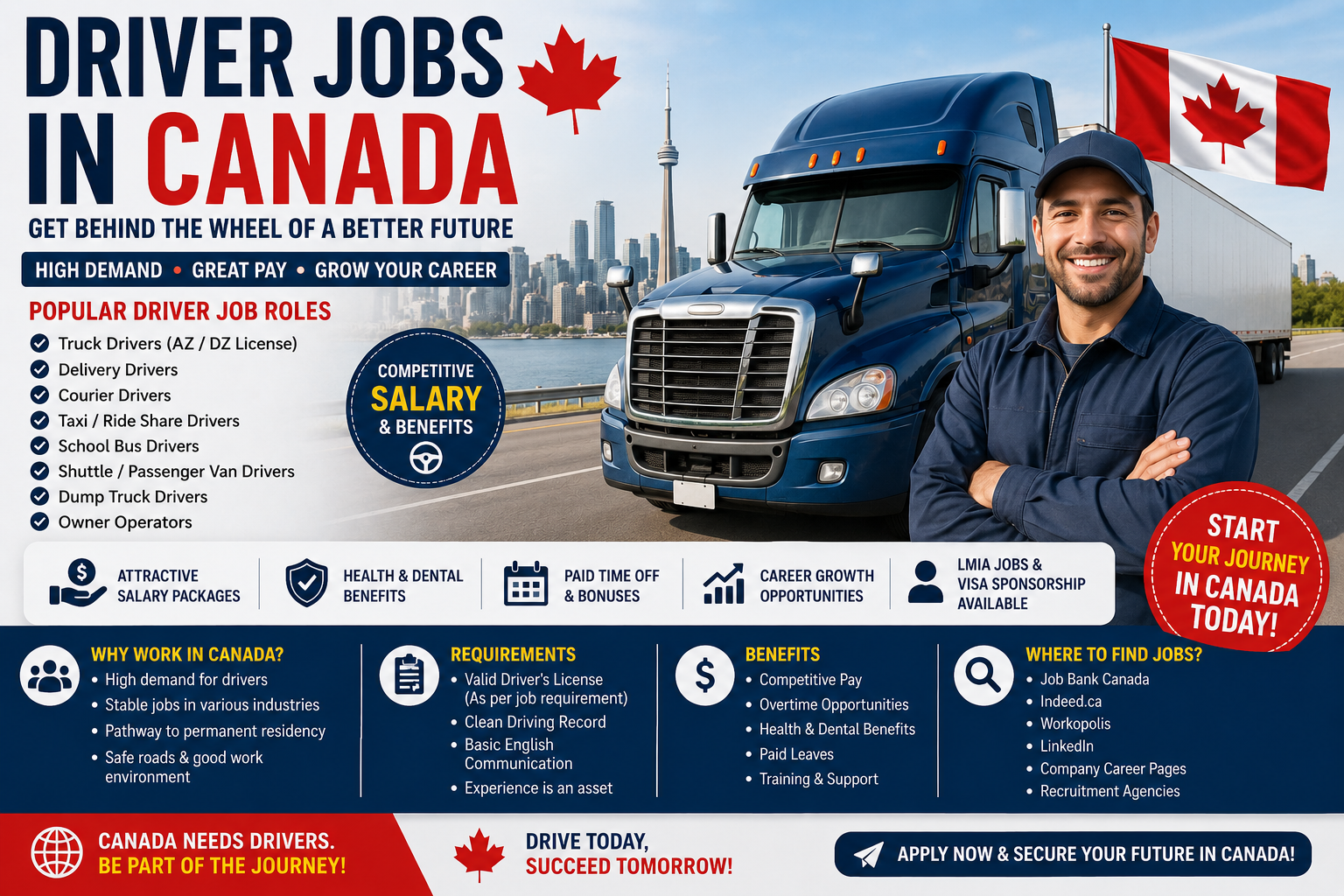
Canada’s transportation sector is short tens of thousands of drivers, and that gap has pushed wages up and opened the door wider for both local job seekers and skilled workers abroad. If you’re searching for driver jobs in Canada, this guide breaks down what the work actually pays, which licence and training you need, how foreign drivers can get a work permit or permanent residency, and where the real job openings are — without the recruitment-agency sales pitch.
Last updated: August 2026
Quick Summary: Driver Jobs in Canada at a Glance
| Detail | Information |
|---|---|
| Common job titles | Transport truck driver, delivery driver, bus driver, taxi/rideshare driver |
| National Occupational Classification (NOC) | 73300 (Transport truck drivers) |
| Average annual salary | Roughly CAD 55,000–85,000 for full-time company drivers |
| Average hourly wage | Roughly CAD 25–31/hour |
| Licence required | Class 1/A commercial licence for long-haul trucking (provincial requirement) |
| Immigration routes | LMIA work permit, Provincial Nominee Programs (PNPs), Federal Skilled Trades Program |
| Driver shortage (2026 estimate) | Around 55,000 unfilled positions nationwide |
Why Driver Jobs Are in High Demand in Canada
Canada’s trucking and logistics industry moves the vast majority of consumer goods, groceries, and construction materials across the country, and the workforce behind it is aging out faster than new drivers are entering. Add in the continued growth of e-commerce and cross-border freight with the United States, and carriers are competing hard for qualified drivers.
This shortage is not a temporary blip. Industry estimates put the current gap at roughly 55,000 unfilled driving positions nationwide, and that pressure has pushed average pay up noticeably over the past two years. For job seekers, that translates into real leverage: signing bonuses, retention pay, and faster promotion into higher-paying specialized routes.
Types of Driver Jobs Available in Canada
“Driver jobs in Canada” covers more ground than long-haul trucking. Here are the main categories:
- Long-haul (over-the-road) truck drivers — Transport freight across provinces or into the U.S., often away from home for days at a time. Highest average pay.
- Local and regional delivery drivers — Same-day or short-route delivery for retail, courier, and grocery companies. More predictable schedules, home most nights.
- Owner-operators — Drivers who own or lease their own truck and contract with carriers or shippers directly. Higher earning potential but more business risk.
- Bus and transit drivers — City transit, school buses, and intercity coach services, usually requiring a Class 2 or Class B licence.
- Taxi and rideshare drivers — Lower barrier to entry, flexible hours, typically only require a standard driver’s licence and vehicle-for-hire permit.
- Specialized haul drivers — Tanker, flatbed, oversized load, and hazardous materials transport, which pay a premium for extra certification.
How Much Do Drivers Earn in Canada? (2026 Salary Breakdown)
Pay varies significantly by province, route type, and years of experience. Based on current job market data, most full-time company truck drivers earn between roughly CAD 55,000 and 85,000 per year, with a national median sitting close to CAD 65,000–68,000. Hourly rates generally fall between CAD 25 and 31 for company drivers.
Estimated Salary by Experience Level
- Entry-level (0–2 years): Roughly CAD 45,000–55,000/year
- Mid-level (3–7 years): Roughly CAD 60,000–80,000/year
- Experienced (8+ years) with cross-border or specialized endorsements: Roughly CAD 80,000–100,000+/year
Estimated Salary by Province
Alberta and British Columbia tend to lead the country in average driver pay, largely due to oil-sands logistics, resource-sector competition, and mountain-route specialization. Ontario follows closely because of its dense freight corridors around Toronto and the U.S. border. Quebec, Manitoba, and Saskatchewan generally sit slightly lower but still offer solid, stable income relative to the local cost of living.
Long-haul and cross-border drivers consistently out-earn local delivery drivers, since the job demands more time away from home, more certification, and more responsibility for the load.
Note: These figures are general estimates drawn from public job-market and salary data as of mid-2026. Actual pay depends on your employer, province, route type, and experience — always confirm current numbers directly with employers or Canada’s official Job Bank.
Requirements to Work as a Driver in Canada
For Canadian Residents and Citizens
- A valid provincial driver’s licence — Class 1/A for long-haul tractor-trailers, Class 3/D for straight trucks, Class 2/B for buses.
- Completion of Mandatory Entry-Level Training (MELT) in provinces that require it for new Class 1 licence holders.
- A clean driving abstract and passing a medical fitness exam.
- For cross-border U.S. routes, a valid passport and, in some cases, a FAST card.
For Foreign Workers
Foreign nationals typically need one of the following to legally work as a driver in Canada:
- A job offer supported by a positive Labour Market Impact Assessment (LMIA) from a Canadian employer, which allows the employer to hire a foreign worker because no Canadian was available for the role.
- A work permit issued based on that LMIA, allowing you to work legally for the sponsoring employer.
- A recognized provincial commercial driver’s licence, obtained after arriving in Canada (foreign licences are generally not directly transferable).
Immigration Pathways for Truck Drivers (NOC 73300)
Truck driving is classified under NOC 73300 in Canada’s National Occupational Classification system, and it remains one of the more accessible skilled-trade occupations for immigration. The main routes are:
- LMIA-backed work permit — The most common entry point. A Canadian trucking or logistics company sponsors your work permit after failing to fill the role locally.
- Provincial Nominee Programs (PNPs) — Provinces such as Alberta, Saskatchewan, Manitoba, British Columbia, and New Brunswick regularly nominate experienced truck drivers through dedicated skilled-worker or employer-driven streams.
- Federal Skilled Trades Program (FSTP) via Express Entry — Available to drivers with qualifying Canadian or foreign work experience, a valid job offer or certificate of qualification, and a minimum language benchmark (typically CLB 4).
- Canadian Experience Class (CEC) — Once you’ve accumulated qualifying Canadian work experience on a work permit, you may become eligible to apply for permanent residency through this Express Entry category.
Most successful applicants follow a “work permit → Canadian experience → permanent residency” sequence rather than trying to qualify for PR before ever setting foot in Canada. Requirements, processing times, and eligible occupations change periodically, so always verify current criteria on the official Immigration, Refugees and Citizenship Canada (IRCC) website or with a licensed immigration consultant (RCIC) before applying.
How to Apply for Driver Jobs in Canada: Step-by-Step
- Check your eligibility — Confirm your driving experience, licence class, and language ability match the requirements for the route type and immigration stream you’re targeting.
- Search verified job postings — Use Canada’s official Job Bank, LinkedIn, and established trucking-company career pages rather than unverified agencies promising guaranteed visas.
- Prepare your documents — Driving abstract, employment references, licence history, resume tailored to Canadian formatting, and language test results if applicable.
- Apply directly to employers with LMIA history — Larger carriers with a track record of sponsoring foreign drivers tend to have smoother, faster processes.
- Secure a job offer and LMIA (if applying from abroad) — Your employer applies for the LMIA on your behalf before you apply for the work permit.
- Apply for your work permit — Submit your application through IRCC once the LMIA is approved.
- Complete any provincial licensing requirements — Convert or obtain your Canadian commercial licence after arrival, including any required MELT training.
- Build Canadian work experience toward PR — Track your eligible work months if you plan to apply for permanent residency later.
Is Driving a Good Career Choice in Canada Right Now?
For most candidates, yes — with realistic expectations. The nationwide driver shortage means job security is high and wages have been trending upward faster than many other blue-collar occupations. It’s also one of the few well-paying careers that doesn’t require a university degree, making it attractive for both Canadian workers changing careers and newcomers building a life in the country.
That said, long-haul trucking involves real trade-offs: extended time away from family, physically demanding hours, and a licensing process that takes real time and money to complete properly. Local delivery and transit driving offer a better work-life balance but typically pay less than long-haul or specialized routes.
Frequently Asked Questions
What is the average salary for a truck driver in Canada in 2026? Most full-time company truck drivers earn between roughly CAD 55,000 and 85,000 per year, or about CAD 25–31 per hour, depending on province, route type, and experience.
Can foreigners get truck driving jobs in Canada? Yes. Foreign nationals can work as drivers in Canada through an employer-sponsored LMIA work permit, and many later qualify for permanent residency through Provincial Nominee Programs or the Federal Skilled Trades Program.
Do I need IELTS to work as a truck driver in Canada? It depends on the pathway. Many employer-sponsored work permits don’t require a formal language test, but most permanent residency routes require a minimum language benchmark (often CLB 4), which can be demonstrated through IELTS, CELPIP, or an equivalent test.
What licence do I need to drive a truck in Canada? Long-haul tractor-trailer driving requires a Class 1 (or Class A, depending on the province) commercial driver’s licence, along with completion of Mandatory Entry-Level Training in provinces where it’s required.
Which province pays truck drivers the most? Alberta and British Columbia tend to offer the highest average pay, driven by resource-sector logistics and specialized mountain or oil-sands routes, followed closely by Ontario.
How long does it take to become a truck driver in Canada? Entry-level commercial licence training typically takes a few weeks to a few months, depending on the province and whether you’re completing MELT full-time or part-time.
Final Thoughts
Driver jobs in Canada remain one of the more reliable paths to stable, above-average income for both domestic workers and skilled newcomers, thanks to a labour shortage that shows no sign of closing soon. Whether you’re a Canadian resident considering a career change or an international candidate exploring an LMIA-backed work permit, the opportunity is real — but it pays to verify licensing rules, wage data, and immigration requirements directly through official government sources before making major decisions.