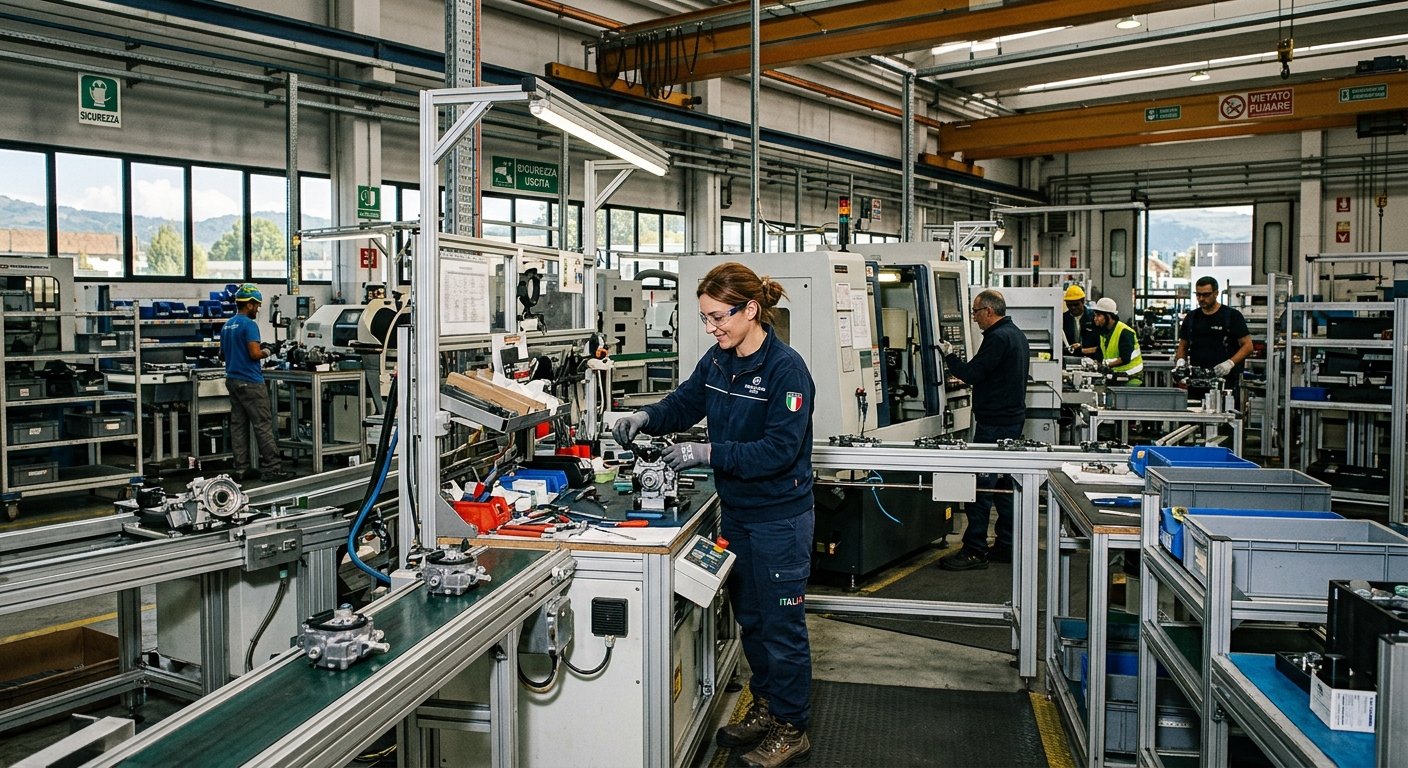
Factory Worker Jobs in Italy
Factory worker jobs in Italy can be an option for people who want to build experience in manufacturing, production, packaging, food processing, logistics, machinery, textiles, furniture, automotive, and other industrial sectors.
Italy has a large and diverse manufacturing industry. Official Italian statistics cover manufacturing sectors including food and beverages, textiles, leather, chemicals, pharmaceuticals, plastics, metal products, machinery, automotive, furniture, and other industries.
However, finding a genuine factory job requires more than simply submitting a CV online. Applicants should understand the job requirements, employment contract, salary structure, work authorization rules, and possible visa requirements before accepting an offer.
This guide explains how factory worker jobs in Italy work, what qualifications employers may look for, how much workers can potentially earn, and how non-EU applicants can legally apply.
Why Consider Factory Worker Jobs in Italy?
Italy is well known for manufacturing and industrial production. Manufacturing remains an important part of the country’s economy, employing a significant share of the workforce and generating substantial economic value. According to Istat, manufacturing enterprises accounted for 23.5% of employment in 2023.
Factory employment can be available in different types of businesses, from small specialized manufacturers to large industrial companies.
Some common advantages may include:
- Full-time employment opportunities
- Training provided by some employers
- Opportunities for overtime depending on the workplace
- Experience in European manufacturing
- Potential career progression
- Employment contracts governed by applicable Italian labor rules
- Opportunities in different manufacturing sectors
Job availability changes frequently, so applicants should always verify that a vacancy is currently open before making travel or financial arrangements.
Types of Factory Worker Jobs in Italy
The term “factory worker” covers many different occupations. Your duties and requirements will depend on the industry and employer.
1. Production Line Worker
Production workers may operate on assembly or production lines and help manufacture finished products.
Typical duties can include:
- Operating production equipment
- Assembling components
- Monitoring production processes
- Checking products
- Moving materials
- Maintaining a clean work area
- Following workplace safety procedures
2. Packaging Worker
Packaging workers prepare products for storage, transportation, or distribution.
Typical responsibilities include:
- Packing finished products
- Labeling boxes
- Checking quantities
- Inspecting packaging
- Preparing products for shipment
- Maintaining production-area cleanliness
3. Food Factory Worker
Italy has an important food manufacturing industry. Jobs may involve food preparation, processing, packaging, quality checks, or warehouse operations.
Workers may be required to follow strict hygiene and food-safety procedures.
4. Warehouse and Production Worker
Some factories combine production and warehouse activities.
Duties can include:
- Loading and unloading materials
- Moving products
- Preparing orders
- Inventory assistance
- Packaging
- Using basic warehouse equipment
Specific equipment such as forklifts normally requires appropriate training or authorization.
5. Machine Operator
Machine operators work with manufacturing equipment used to produce or process goods.
Employers may prefer applicants with:
- Previous factory experience
- Technical knowledge
- Machine-operation experience
- Basic mechanical skills
- Understanding of workplace safety
6. Metal and Machinery Factory Worker
Italy has significant manufacturing activity in machinery, metal products, electrical equipment, and related industries. Istat’s manufacturing classification includes metal products, machinery, electrical equipment, electronics, automotive, and other industrial sectors.
Jobs can include machine assistant, assembly worker, production operator, metalworking assistant, and maintenance-related positions.
7. Textile and Garment Factory Worker
Textile and clothing businesses can employ workers in areas such as:
- Sewing
- Cutting
- Finishing
- Quality inspection
- Packing
- Production assistance
Experience with industrial sewing machines or garment production can be useful for specialized positions.
8. Automotive Factory Worker
Italy has a long-established automotive manufacturing sector. Potential positions can include assembly, component production, quality control, warehouse support, and machine operation.
These positions may have more specific technical and safety requirements than entry-level general production jobs.
Factory Worker Jobs in Italy for Foreign Workers
Foreign workers can legally work in Italy if they meet the applicable immigration and employment requirements.
For non-EU nationals who are outside Italy, employment entry is generally connected to Italy’s immigration rules and, in many cases, the annual Decreto Flussi quota system.
The Italian Ministry of Foreign Affairs explains that non-EU entry for employment generally takes place within the framework of entry quotas established under the Decreto Flussi. The employer normally begins the process by requesting work authorization, known as a nulla osta, from the Sportello Unico per l’Immigrazione.
This means that simply receiving an online message claiming to be a “job offer” does not automatically give someone the right to work in Italy.
Italy Work Visa for Factory Workers
If you are a non-EU worker living outside Italy, you generally need the appropriate employment authorization and visa before starting work.
A typical process can involve:
- Finding a legitimate Italian employer.
- Receiving a genuine employment offer.
- The employer submitting the required application for work authorization.
- Obtaining the nulla osta where required.
- Applying for the appropriate Italian employment visa.
- Entering Italy legally.
- Completing the required residence and employment formalities after arrival.
The Italian Embassy in Islamabad’s current checklist for subordinate employment includes the work authorization issued by the Sportello Unico per l’Immigrazione and an employment contract among the required documentation.
Visa procedures can change, so applicants should check the Italian diplomatic mission responsible for their country before submitting documents.
Can I Get a Factory Job in Italy Without a Work Visa?
If you are a non-EU national who needs authorization to work in Italy, you should not travel on a tourist visa with the intention of starting unauthorized employment.
Legal employment requires following the applicable immigration process.
The Italian Ministry of Foreign Affairs states that employers generally need to apply for work clearance for non-EU workers before the worker applies for the relevant employment visa.
Always verify your personal situation with an official Italian immigration or consular authority.
Requirements for Factory Worker Jobs in Italy
Requirements vary by employer and position. Entry-level factory jobs may have fewer formal education requirements, while technical positions can require qualifications and previous experience.
Common requirements may include:
- Valid passport
- Legal authorization to work
- Employment contract
- Relevant work experience
- Basic physical fitness for job duties
- Ability to follow safety instructions
- Reliability and punctuality
- Basic communication skills
- Willingness to work shifts when required
- Previous factory experience for some positions
For specialized jobs, employers may require technical certificates, machine-operation experience, driving or equipment qualifications, or other professional credentials.
Is Italian Language Required for Factory Jobs?
Italian language requirements depend on the employer and position.
Some production jobs may require only basic Italian, especially where duties are repetitive and training is provided. Other positions require stronger communication skills because workers must understand safety instructions, machinery procedures, quality requirements, and workplace communication.
Learning basic Italian can therefore improve your chances of finding and keeping employment.
Useful workplace words and phrases can include:
- Sicurezza – Safety
- Attenzione – Attention
- Macchina – Machine
- Produzione – Production
- Controllo qualità – Quality control
- Magazzino – Warehouse
- Turno – Shift
- Lavoro – Work
Factory Worker Salary in Italy
One of the most common questions is: How much does a factory worker earn in Italy?
There is no single nationwide salary for factory workers. Pay depends on factors such as:
- Job title
- Industry
- Region
- Experience
- Working hours
- Shift work
- Overtime
- Employment contract
- Applicable collective agreement
- Employer
Italy does not currently have a single statutory national minimum wage. Pay floors are commonly established through collective bargaining and employment agreements. EURES notes that remuneration is normally determined through individual or collective employment contracts.
Therefore, websites advertising one fixed salary for every factory worker in Italy should be treated carefully.
What Should You Check in a Salary Offer?
Before accepting a factory job, check:
- Gross monthly salary
- Expected net salary
- Number of working hours
- Overtime rate
- Shift allowances
- Bonuses
- Holiday entitlement
- Social security contributions
- Accommodation arrangements
- Transportation arrangements
- Contract duration
The gross salary is not the same as the amount you receive in your bank account because taxes and social contributions may be deducted.
Working Hours for Factory Workers
Factory schedules depend on the employer and production system.
Some factories operate:
- Day shifts
- Evening shifts
- Night shifts
- Rotating shifts
- Weekend shifts
Before accepting a position, carefully read the employment contract and ask the employer how the working schedule is organized.
Workers should also confirm how overtime, rest periods, holidays, and shift allowances are handled.
Where Are Factory Jobs Available in Italy?
Manufacturing is spread across different parts of Italy, and opportunities vary by industry.
Industrial employment can be found in areas associated with:
- Automotive manufacturing
- Machinery
- Metalworking
- Food production
- Furniture
- Textiles
- Chemicals
- Pharmaceuticals
- Electronics
- Packaging
- Logistics
Istat’s current manufacturing sector data separately tracks industries ranging from food and textiles to chemicals, pharmaceuticals, machinery, automotive, furniture, and equipment manufacturing.
Instead of focusing only on one city, job seekers should search by industry + job title + region.
For example:
- Production worker in Northern Italy
- Factory operator in Lombardy
- Packaging worker in Emilia-Romagna
- Food production worker in Veneto
- Machine operator in Piedmont
How to Find Factory Worker Jobs in Italy
The safest approach is to use legitimate recruitment channels and verify the employer before providing sensitive documents or paying money.
Step 1: Prepare Your CV
Create a simple, professional CV that includes:
- Full name
- Contact information
- Work experience
- Factory skills
- Machine experience
- Education
- Technical qualifications
- Language skills
- References where appropriate
If you have worked in manufacturing before, clearly describe your responsibilities.
Step 2: Search for Relevant Job Titles
Don’t search only for “factory worker.”
Try terms such as:
- Production worker
- Production operator
- Operatore di produzione
- Addetto alla produzione
- Addetto al confezionamento
- Machine operator
- Assembly worker
- Warehouse worker
- Quality control assistant
- Packaging worker
Using both English and Italian keywords can help you find a wider range of vacancies.
Step 3: Verify the Employer
Before accepting a job, check:
- Company name
- Company website
- Business address
- Job description
- Employment contract
- Contact details
- Recruitment agency information
Be particularly careful if someone promises a visa or job without a proper employment process.
Step 4: Ask About the Contract
Before paying any recruitment-related fee or making travel arrangements, request written information about:
- Employer
- Position
- Salary
- Working hours
- Contract length
- Workplace location
- Accommodation, if offered
- Visa/work authorization arrangements
Step 5: Follow the Legal Immigration Process
If you are a non-EU applicant outside Italy, the employer normally has an important role in obtaining the required work authorization before the visa stage.
Factory Worker Jobs in Italy for Pakistanis
Pakistani workers interested in Italian factory jobs should use the same legal process as other non-EU applicants who require authorization.
If you are applying from Pakistan, do not rely on social media advertisements that promise a guaranteed Italian work visa.
The official Italian Embassy in Islamabad publishes documentation requirements for subordinate employment visas, including the Nulla Osta and employment contract.
A genuine employment process should involve identifiable employer information and official documentation.
Documents You May Need
Depending on your circumstances and the specific visa process, you may need documents such as:
- Valid passport
- Visa application form
- Passport photographs
- Work authorization/Nulla Osta
- Employment contract
- CV
- Evidence of work experience
- Educational or professional certificates where relevant
- Police clearance where required
- Other documents requested by the Italian authorities
The exact requirements can change and may depend on the applicant’s country of residence and type of employment.
Always use the latest official checklist from the relevant Italian embassy or consulate.
How to Avoid Italy Job Scams
Unfortunately, fake overseas job advertisements can target people searching for European employment.
Be cautious if a recruiter:
- Guarantees a visa
- Guarantees a job without an interview
- Requests large payments before providing documentation
- Uses only WhatsApp or social media
- Refuses to provide an employer’s full name
- Sends an employment contract with suspicious details
- Promises an unusually high salary for an entry-level job
- Tells you to travel on a tourist visa and work illegally
- Requests your passport without a legitimate reason
A genuine job opportunity should be independently verifiable.
Important Warning
Never assume that paying a recruiter guarantees a work permit or visa.
Italian authorities determine immigration permissions according to the applicable rules. A private person or recruitment agent cannot legitimately guarantee that a visa will be approved.
Skills That Can Improve Your Chances
Applicants can improve their competitiveness by developing practical skills.
Useful skills include:
- Basic Italian
- Workplace safety awareness
- Machine operation
- Quality control
- Packaging
- Assembly
- Warehouse procedures
- Basic computer skills
- Mechanical knowledge
- Forklift or equipment qualifications where legally applicable
- Previous manufacturing experience
Technical experience can be especially valuable for machine operator and maintenance-related positions.
Factory Worker Career Growth in Italy
Factory employment does not necessarily have to remain an entry-level position.
With experience and additional training, workers may move toward roles such as:
- Senior production operator
- Machine operator
- Quality control worker
- Team leader
- Warehouse coordinator
- Maintenance assistant
- Production supervisor
Career progression depends on the employer, qualifications, performance, language ability, and available vacancies.
Pros and Cons of Factory Work in Italy
Advantages
- Opportunities across multiple manufacturing sectors
- Practical work experience
- Potential overtime opportunities
- Possibility of career development
- Experience with European production systems
- Different types of manufacturing jobs
Challenges
- Shift work may be required
- Some jobs are physically demanding
- Italian language skills may be important
- Housing costs vary considerably by location
- Competition can exist for desirable positions
- Non-EU workers must complete the appropriate immigration process
Understanding both the benefits and challenges can help job seekers make a realistic decision.
Tips for Applying for Factory Worker Jobs in Italy
Follow these practical tips:
- Create a professional CV.
- Highlight relevant factory experience.
- Learn basic Italian workplace vocabulary.
- Search using Italian job titles as well as English terms.
- Research the company before applying.
- Read every employment contract carefully.
- Ask whether the employer supports the required work authorization process.
- Never assume a tourist visa permits employment.
- Do not pay money simply because someone promises a guaranteed visa.
- Use official government sources to verify immigration requirements.
Frequently Asked Questions About Factory Worker Jobs in Italy
Are factory worker jobs available in Italy?
Yes, Italy has a broad manufacturing sector covering food, machinery, metal products, automotive, textiles, pharmaceuticals, chemicals, furniture, electronics, and other industries. However, individual vacancies depend on current employer demand and location.
Can foreigners work in Italian factories?
Foreign nationals can work in Italy when they meet the applicable employment and immigration requirements. Non-EU workers who require authorization generally need the appropriate work clearance and visa process before starting employment.
Do factory workers need to speak Italian?
Not every factory position has the same language requirement. Some employers may accept basic Italian, while positions involving safety procedures, machinery, supervision, or customer-related tasks may require stronger language skills.
What is the salary of a factory worker in Italy?
There is no single salary applicable to every factory worker. Pay varies according to the job, region, experience, hours, contract, collective agreement, and employer. Italy does not have one statutory national minimum wage.
Can I apply for an Italian factory job from abroad?
Yes, you can search and apply from abroad. If you are a non-EU worker who needs immigration authorization, the employer and Italian authorities generally have to complete the required work authorization process before the employment visa can be issued.
Is a work visa guaranteed after receiving a job offer?
No. A job offer does not automatically guarantee visa approval. The relevant Italian authorities must process the required authorization and visa application according to applicable rules.
Can I work in Italy on a tourist visa?
You should not use a tourist visa as a substitute for the required employment authorization. Non-EU workers who need authorization must follow the applicable employment visa and immigration process.
How can I avoid fake factory job offers?
Verify the employer independently, request a written contract, check official immigration requirements, and be cautious about anyone demanding large payments or promising a guaranteed visa.
What qualifications are needed for factory work?
Requirements depend on the position. General production jobs may accept applicants with limited formal qualifications, while machine operators, technicians, electricians, welders, and other specialized workers may need relevant training or experience.
Final Thoughts on Factory Worker Jobs in Italy
Factory worker jobs in Italy can provide opportunities in manufacturing industries such as food production, packaging, machinery, metalworking, automotive, textiles, furniture, chemicals, and electronics.
However, job seekers should approach the process realistically. There is no universal salary, no guaranteed vacancy, and no legitimate shortcut around immigration requirements.
For non-EU workers, the most important steps are to find a genuine employer, understand the employment contract, verify the required work authorization, and use official Italian immigration and consular information when applying for a visa.
Italy’s manufacturing sector remains diverse, and Istat continues to track a wide range of manufacturing industries and their economic performance.
Always verify current job vacancies, immigration rules, visa requirements, and employment conditions before making financial or travel commitments.
Author’s Note / EEAT Disclaimer
This article is intended for general informational purposes and should not be considered legal, immigration, or employment advice. Immigration rules, work-permit quotas, visa procedures, salaries, and job vacancies can change.
For immigration matters, consult the relevant Italian government authority or Italian diplomatic mission. For employment questions, carefully review your employment contract and applicable collective agreement.
Last Updated: August 2026