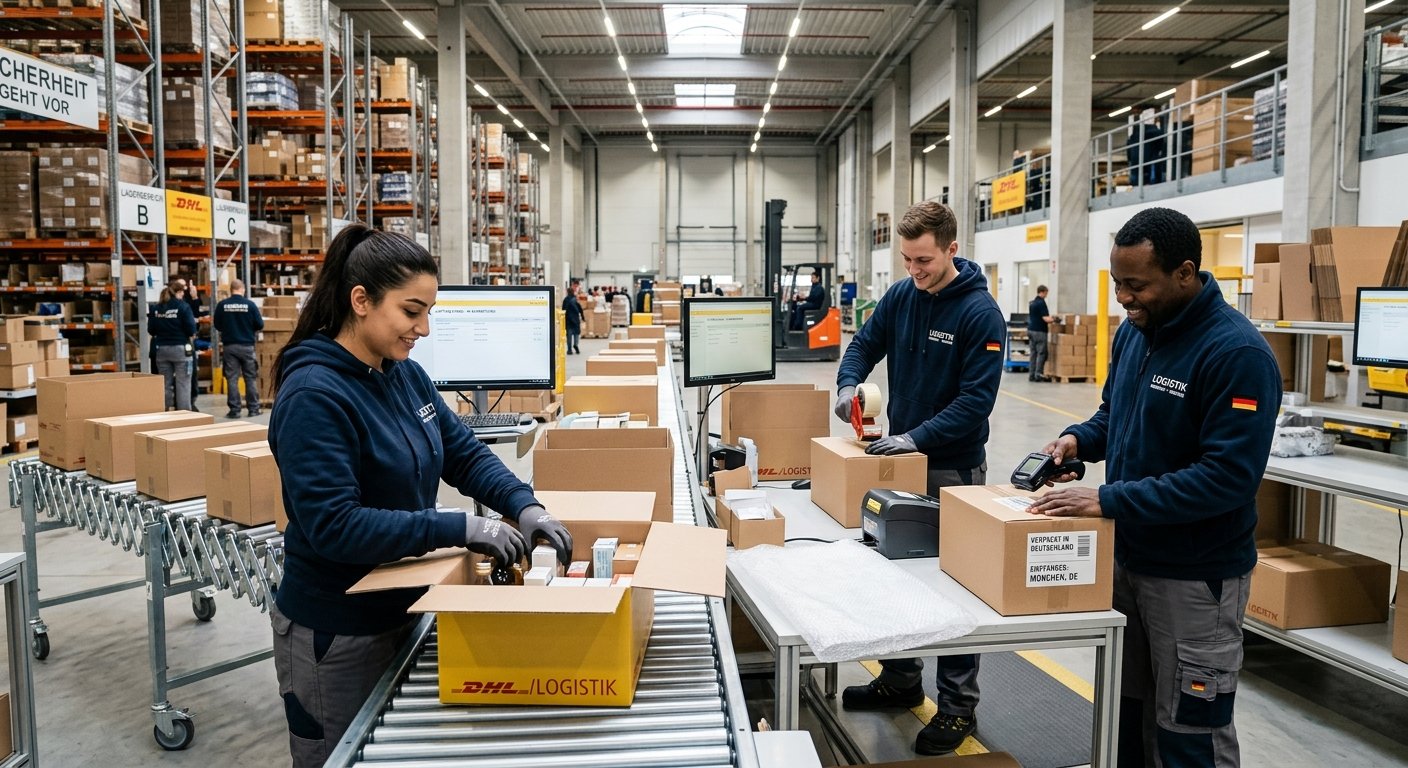
Germany’s warehouses and logistics centers are short-staffed, and packing worker jobs in Germany have become one of the more realistic entry points into the country’s job market for people without a university degree. But the online job market is also full of exaggerated “visa sponsored, €2,900/month, free accommodation” listings that don’t hold up under scrutiny.
This guide sticks to verifiable numbers — current minimum wage law, published salary data, and official visa routes — so you can judge for yourself whether this path makes sense for you.
Table of Contents
- What Does a Packing Worker Actually Do?
- Why Germany Needs Packing and Warehouse Workers
- Packing Worker Salary in Germany (2026 Data)
- Can Non-EU Citizens Get a Packing Job in Germany?
- Skills and Requirements
- How to Apply: Step-by-Step
- Where to Find Legitimate Job Openings
- Red Flags: How to Avoid Job Scams
- Frequently Asked Questions
What Does a Packing Worker Actually Do?
A packing worker (in German, Verpackungsmitarbeiter or Lager- und Verpackungshelfer) prepares goods for shipping or storage inside a warehouse, distribution center, or factory. Typical daily tasks include:
- Sorting and inspecting products before packaging
- Placing items into boxes, cartons, or containers by hand or with light machinery
- Labeling packages and checking them against order slips
- Operating basic packaging or sealing machines (training is usually provided on the job)
- Stacking, palletizing, and preparing goods for pickup
- Keeping the work area clean and following workplace safety rules
Most roles don’t require prior formal qualifications, which is part of why this job category attracts so many first-time applicants to the German labor market.
Why Germany Needs Packing and Warehouse Workers
Germany is one of Europe’s largest logistics hubs, and e-commerce growth has outpaced the domestic labor supply in several regions. Reports on Germany’s 2026 labor market consistently list transport and logistics — including warehouse operators, packers, and forklift drivers — among the sectors facing persistent staffing gaps, alongside healthcare, construction, and IT.
It’s worth being precise about what this means, though: “in demand” doesn’t automatically mean “on the official shortage occupation list” (Engpassberufe) that unlocks the easiest visa routes. Entry-level packing roles sit at the lower-skilled end of logistics, while the strongest visa advantages in Germany’s shortage system are generally reserved for licensed drivers, trained warehouse specialists, and supply chain coordinators with recognized vocational qualifications. Understanding this distinction early will save you time later.
Packing Worker Salary in Germany (2026 Data)
Germany’s statutory minimum wage is €13.90 gross per hour as of January 1, 2026, rising to €14.60 per hour from January 1, 2027. For a standard 40-hour week, that works out to roughly €2,409 gross per month, or about €1,700–€1,900 net per month after taxes and social contributions, depending on your tax class and personal circumstances.
Independent salary data for packing and warehouse roles specifically shows:
| Role | Typical Annual Gross Salary | Typical Hourly Rate |
|---|---|---|
| Entry-level packer | €24,000 – €31,000 | €13.90 – €15 |
| Experienced packer / packing line worker | €31,000 – €34,500 | €15 – €17 |
| General warehouse worker | €31,000 – €36,500 | €14 – €18 |
These figures come from aggregated compensation surveys (Glassdoor, ERI SalaryExpert) and reflect gross pay before tax. Actual pay varies by:
- Region — Munich, Frankfurt, and Stuttgart tend to pay more, but living costs are higher there too
- Employer type — direct employment often pays more consistently than agency (Zeitarbeit) placements, though agencies are frequently the fastest entry point for newcomers
- Shift work — night and weekend shifts usually carry a pay differential
- Experience and certifications — a forklift license (Staplerschein) can meaningfully increase your pay
Be skeptical of any listing that advertises a flat rate far above these ranges (for example, “€2,900/month guaranteed, no experience needed”) without a verifiable employer name and written contract. See the scam warning section below.
Can Non-EU Citizens Get a Packing Job in Germany?
Yes, but it’s important to understand which visa category actually applies, because packing work rarely qualifies for Germany’s higher-profile immigration routes.
EU/EEA and Swiss citizens can work in Germany freely without a visa or work permit.
Non-EU citizens generally have three realistic paths into a role like this:
- Skilled Worker Visa (Fachkräfteeinwanderungsgesetz) — designed for people with recognized vocational training or a relevant qualification. A pure entry-level packing job with no training requirement typically does not meet the bar on its own, but this route matters if you’re aiming for adjacent roles like warehouse specialist or logistics operative.
- Temporary employment agencies (Zeitarbeit) — many international workers enter German logistics through a staffing agency that handles the employment contract and, in some cases, the visa sponsorship paperwork. Always confirm the agency is registered and licensed under German labor law (look for an AÜG license — Arbeitnehmerüberlassungsgesetz).
- The EU Blue Card does not generally apply to unskilled packing roles, since it requires a university degree and a minimum gross salary (€45,934.20/year for shortage occupations, €50,700 for general roles in 2026) — well above typical packer pay.
If you’re not an EU citizen, your most reliable strategy is to secure a written job offer from a verifiable German employer or licensed staffing agency first, then apply for the corresponding work visa at your local German embassy or consulate. The Federal Employment Agency (Bundesagentur für Arbeit, arbeitsagentur.de) is the authoritative source for current visa categories and requirements — always cross-check any recruiter’s claims against it.
Skills and Requirements
You generally don’t need a university degree or formal certification to apply, but the following improve your chances significantly:
- Basic German (A1–A2 level) — many warehouses operate with German-language safety instructions and team communication; some multinational logistics firms accept English
- Physical stamina — the role involves standing, lifting, and repetitive motion for full shifts
- Attention to detail — accuracy matters for order fulfillment and quality control
- Reliability and punctuality — shift-based warehouse work depends on consistent attendance
- A clean employment/immigration record — required for the visa application process
- Optional but valuable: a forklift license (Staplerschein), prior logistics experience, or vocational training in warehouse logistics (Fachlagerist or Fachkraft für Lagerlogistik)
How to Apply: Step-by-Step
- Check your eligibility route. EU/EEA citizens can apply directly. Non-EU citizens should first identify whether they’ll go through a licensed staffing agency or a direct employer sponsoring a Skilled Worker Visa.
- Prepare your documents. A CV in German or English (Europass format works well), a short cover letter, references if available, and any relevant certificates.
- Search verified sources. Use the Federal Employment Agency’s job board (arbeitsagentur.de/jobsuche) and established job platforms rather than unsolicited social media offers.
- Apply directly and verify the employer. Look up the company’s registration, website, and reviews before sharing personal documents or paying any fee.
- Attend the interview. Many warehouse employers conduct interviews via video call; basic German or English communication is usually sufficient.
- Sign a written contract before relocating. Never travel to Germany based on a verbal promise or an offer that isn’t backed by a signed employment contract.
- Apply for your visa/work permit, if required, at the German embassy or consulate in your home country, using the employment contract as supporting documentation.
- Register your address (Anmeldung) upon arrival and complete any required health insurance and tax registration steps once in Germany.
Where to Find Legitimate Job Openings
- Bundesagentur für Arbeit (arbeitsagentur.de) — Germany’s official public employment service and job board
- EURES (the European Job Mobility Portal) — the EU’s official cross-border job platform, useful for both EU and non-EU applicants
- Established job boards such as Indeed Germany, StepStone, and Glassdoor, filtered by verified employer profiles
- Licensed staffing agencies (Zeitarbeitsfirmen) with an active AÜG license — verify this status before signing anything
Red Flags: How to Avoid Job Scams
The “unskilled jobs in Germany” niche attracts a disproportionate number of scam listings. Watch for these warning signs:
- Guaranteed high pay (well above the ranges shown above) with no interview or vetting process
- Requests for upfront payment for “visa processing,” “training fees,” or “accommodation deposits”
- Vague employer names, no verifiable company registration, or contact only through WhatsApp/Telegram
- Pressure to make quick decisions or send passport scans before any formal offer
- Promises of guaranteed visa approval — no recruiter or agency can guarantee a government visa decision
If in doubt, verify the employer independently through the Bundesagentur für Arbeit or the German embassy in your country before proceeding.
Frequently Asked Questions
Do I need to speak German to work as a packer in Germany? Not always, but basic German (A1–A2) significantly widens your options and is often required for safety instructions on the warehouse floor.
What is the minimum wage for packing jobs in Germany in 2026? Germany’s statutory minimum wage is €13.90 gross per hour as of January 1, 2026, rising to €14.60 in 2027. Most packing roles pay at or slightly above this rate.
Can I get a work visa for a packing job as a non-EU citizen? It’s possible but limited. Entry-level packing work usually doesn’t meet the criteria for the EU Blue Card. The more realistic routes are a licensed staffing agency (Zeitarbeit) or, for roles with recognized vocational training, the Skilled Worker Visa.
Is packing work in Germany a good long-term career? It’s a reasonable entry point, especially combined with a forklift license or vocational training in warehouse logistics, which can lead to higher-paying roles such as warehouse specialist or logistics coordinator.
How do I avoid job scams when applying from abroad? Never pay upfront fees, always verify the employer’s registration, and use official channels like arbeitsagentur.de or EURES rather than unsolicited offers on social media.